
Crypto Kidnappings: An Economic Analysis
The Returns on Violence Are Rising
Over Fifty Attacks in France
Since 2025, France has become the country where the vast majority of physical attacks linked to cryptocurrencies in the world take place. Of 50 documented attacks on French soil, 38 occurred in the last thirteen months [1]. The phenomenon was described as “marginal” by the French Interior Ministry in 2024 [2]. It has exploded since.
The testimonies are chilling. Retirees tortured for hours so their children would “hand over the crypto.” Fingers severed, filmed, sent as videos to families. Mothers held hostage in front of their children. Victims sealed in plastic bags while their torturers filmed the scene to maximize psychological pressure on relatives. Sixteen hours of brutality inflicted on a 74-year-old retiree in Voiron.
In 1997, James Dale Davidson and Lord William Rees-Mogg published The Sovereign Individual, a book that has proven prophetic in many ways. Their analytical framework rests on an idea most economists and political analysts tend to overlook: it is the costs and returns associated with the use of violence that shape human societies. Hunter-gatherers, agrarian empires, industrial states, and now information societies — each stage is defined by a different relationship to violence.
“They put forward two major new concepts that allow us to understand the profound revolution ahead: the logic of violence and the returns on violence (referring to the concept of return on investment). These are praxeological approaches that model the probable behavior of rational actors optimizing their own interests. The central innovation of their approach is to predict how new technologies change the variables in these calculations, and the consequences that follow.” — Francis Pouliot
This analytical framework sheds light on what is happening in France right now.
Davidson and Rees-Mogg wrote:
“The reason that people resort to violence is that it often pays. In some ways, the simplest thing a man can do if he wants money is to take it
Crime pays, and what is currently unfolding in France illustrates this with clinical precision.
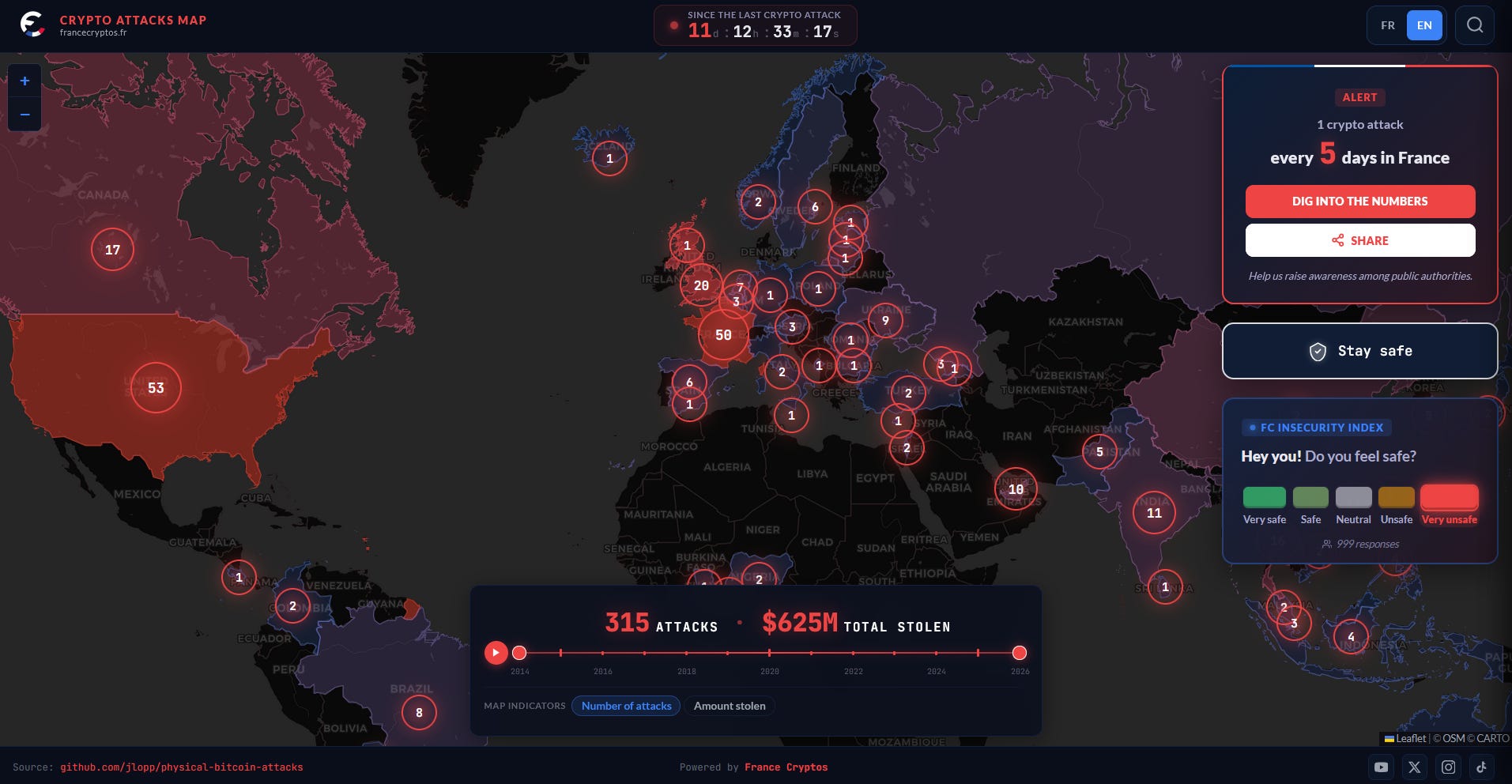
Source : https://map.francecryptos.fr/ ; https://map.francecryptos.fr/guide-securite-crypto
The Returns on Violence Are Rising
The pattern is always the same. A mastermind based abroad, in a country with weak judicial cooperation with France — Morocco comes up in several cases, but other jurisdictions are involved too. He recruits operatives on social media: young men paid a few hundred euros to kidnap, torture, and mutilate strangers [3]. These foot soldiers don’t know the identity of whoever is giving the orders. If they get arrested, the chain doesn’t lead back. They grasp neither the gravity of what they’re doing, nor the sentences they face — twenty years for kidnapping, thirty if acts of torture are charged. No long-term thinking, no empathy for the victims. Disposable cannon fodder, in the most literal sense.
From the mastermind’s perspective, the economic calculus is entirely rational. He doesn’t leave home and runs everything remotely. If the operation succeeds, he potentially collects millions through a crypto transaction which, unlike bank transfers, has no standard ceiling on amount (though it remains traceable). If it fails, he loses replaceable operatives who can be recruited again in hours. The numbers confirm it: of documented attacks, roughly 60% fail, 10% see funds recovered by police, and 30% result in a permanent theft [1]. A high failure rate, but one that does nothing to dent the model’s profitability: a single “successful” operation like the La Rochelle attack in December 2025 — 10 million euros, unrecovered — is enough to fund hundreds of failed attempts while remaining highly profitable.
For the operatives, however, this should look far less rational on the face of it. They are poorly paid, potentially face heavy sentences, and receive nothing more than a vague promise of a cut. Yet the lack of severity from the justice system seems to encourage them to keep going rather than to deter them.
Kidnapping had virtually disappeared from France since the late 1970s, the era of the Baron Empain affair. It systematically failed at the point of ransom handover, when the kidnappers would get caught. Cryptocurrencies have eliminated that bottleneck. No more briefcase in a parking lot.
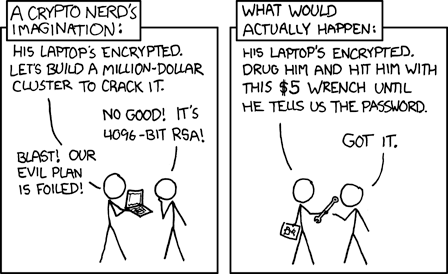
The returns on violence, in the sense Davidson and Rees-Mogg intended, have just spiked. Crypto investors enjoyed a few good years without having to worry about this problem. The violence market is reverting to the mean, and those who thought they were exempt are discovering that securing wealth has a cost, and that being your own bank carries significant risks. The famous $5 wrench attack meme has become reality.
And these returns are all the higher because the judicial response isn’t keeping up. Out of dozens of indictments, the convictions can be counted on one hand: two men sentenced in Amiens in February 2026 for the Revelles case (9 and 5 years) [4], sentences of 10 months to 2 years for an attempted kidnapping in Paris [5]. The rest of the proceedings drag on. Some suspects are placed under mere judicial supervision. Six attacks took place in two weeks in early January 2026. The signal sent to criminals is one of impunity. It’s the targets and victims who are told to keep a low profile.
Easy Targets, Flagged by the State and the Media
Criminals need one precise piece of information to operate: who holds how much, and where they live. This information comes from several sources.
The first is the investors themselves. An interview with a journalist who covers major fortunes sums up the problem. Traditional ultra-wealthy individuals — old-money industrialists — learned long ago to minimize their public exposure. Crypto holders, by contrast, are often recently wealthy and sometimes display their success on social media. All information a mastermind abroad can exploit with a few hours of open-source research.
The second source is the press. Systematically labeling victims as “crypto millionaires” or “speculators” amounts to painting a target on their backs. This media coverage reinforces the notion that these fortunes are illegitimate, easy to extort, and that their holders deserve little sympathy. The press doesn’t create the kidnappings, but it feeds the targeting process and normalizes the perception of the crime.
The third source is the companies that collect personal data. The list of breaches is staggering and never ending. Each breach feeds a secondary market where criminals can cross-reference physical addresses, identities, and crypto holdings. If you run a business in the sector, your identity is displayed in the clear on the internet; a few reverse lookups are all it takes to locate your home or your family’s.
Finally, the last source is the state itself. In June 2025, Ghalia C., a tax official in Bobigny, was indicted for transmitting information from fiscal databases to criminals — including files on crypto investors [4]. The tax authority, self-proclaimed guardian of financial transparency, became a leak point to organized crime. And the state’s reaction to this failure? No questioning of the data collection itself. No protective measures for exposed citizens. The only response was to open an investigation into the agent while continuing to demand the same declarations from the same taxpayers.
It’s going to get worse. Since January 1, 2026, the European directive DAC8 requires crypto platforms to report to tax authorities the full identity of their users, the value of their portfolios as of December 31, and the details of all their annual transactions. Name, address, date of birth, wealth: everything is centralized in government databases. Under the guise of combating money laundering, the European Union has built the most comprehensive catalogue ever conceived for criminals. All it takes is one hack or one corrupt civil servant for this data to end up in the hands of masterminds abroad. The state doesn’t protect the data it collects, doesn’t punish those who attack its citizens with sufficient severity, and keeps demanding more.
The Individual, Caught in a Vise
Let’s analyze the situation through the same lens as Davidson and Rees-Mogg.
On one side, a state that is tightening regulation. It demands total transparency over the digital wealth of its citizens. It centralizes their data in systems it cannot protect. When one of its agents sells that data to criminals, it opens an investigation. Then it keeps asking the same citizens to declare their assets and offers them a hotline. Forty kidnappings in a few months, and the state’s only response is a call for “individual vigilance.” The state that forces you to declare your holdings is the same one that abandons you when those declarations put you in danger.
On the other side, ruthless criminals who exploit precisely this data to show up at your door at six in the morning, slash your father’s fingers, film your mother tied up, and demand millions you probably don’t even have. All for a few hundred euros in pay, with the certainty that the sentences they face will never be applied in full.
The individual is caught in a vise between the two. If he declares his wealth to an administration that leaks it, he feeds a system that puts him in danger. He obeys laws that increase his vulnerability. If he doesn’t declare, he undermines the returns of the “legitimate monopoly on violence.”
Davidson and Rees-Mogg anticipated this exact configuration:
“When the payoff for organizing violence at a large scale tumbles, the payoff from violence at a smaller scale is likely to jump. Violence will become more random and localized. Organized crime will grow in scope.”
This is precisely what investigators from the police describe when they talk about foreign masterminds recruiting disposable operatives via Telegram. Violence has fragmented. It is no longer the monopoly of the state, and the state is no longer able to protect those it forces into transparency.
Defection, or Voting with Your Feet
The Sovereign Individual doesn’t just diagnose the problem. The book also identifies the way out.
“Information societies promise to dramatically reduce the returns to violence, in part because they transcend locality. The virtual reality of cyberspace will be as far beyond the reach of tyrants as one can imagine.”
The solution for the individual caught between the collecting state and the predatory criminal is the same in both cases: reduce your attack surface and improve your digital hygiene. Don’t appear in the databases that feed both sides. Don’t entrust your wealth to systems that neither the state nor the platforms know how to protect. Make yourself invisible to predators, whether they wear balaclavas or suits.
In practice, this means leaving jurisdictions that centralize your data, maximize your tax rate, and fail to apply criminal penalties severe enough to deter crime. It means using tools with no server to hack and no civil servant to corrupt. It means stopping your contribution to a system in which you’re the product when things go well and the victim when they don’t.
It means not being the low hanging fruit, and voting with your feet. The authors didn’t mince words. Civic loyalty to the nation-state is, in their view, a relic of the twentieth century. Those who still believe they can improve the situation through voting and politics will have front-row seats to the collapse of the welfare state.
When a 74-year-old retiree is tortured for sixteen hours because the law mandates the collection of sensitive data [3], prevents self-defense, and fails to deter criminals, the question is no longer whether the system works. The question is how long you’re going to keep being part of it.
Sources:
[1] @ProfEduStream, “Analysis of 47 documented crypto attacks in France,” February 2026 —


[2] Le Progrès / AFP, “Over 40 kidnappings and hostage-takings linked to crypto since January,” April 16, 2026 — https://www.leprogres.fr/faits-divers-justice/2026/04/16/deja-plus-de-quarante-enlevements-et-sequestrations-lies-aux-cryptomonnaies-depuis-janvier
[3] France Info / Aurélien Thirard, “16 hours of abuse: the chilling account of a retiree kidnapped over crypto,” April 15, 2026 — https://www.franceinfo.fr/replay-radio/le-choix-franceinfo/temoignage-le-but-c-est-que-ton-fils-sorte-les-millions-16-heures-de-sevices-le-recit-glacant-d-un-retraite-victime-d-un-enlevement-lie-aux-cryptomonnaies_7907888.html
[4] Cryptoast, “Timeline of crypto violence in France” — https://cryptoast.fr/liste-enlevements-agressions-lies-cryptomonnaies-france/
[5] Le Figaro, “Paris: three offenders convicted over attempted crypto kidnapping,” April 2, 2026 — https://www.lefigaro.fr/faits-divers/paris-trois-delinquants-condamnes-pour-une-tentative-d-enlevement-sur-fond-de-cryptomonnaie-20260402
Book cited: James Dale Davidson & Lord William Rees-Mogg, The Sovereign Individual (1997). German edition: Das souveräne Individuum, 2024, Konsensus Network.
French edition: L’Individu souverain, translated by Konsensus Network, forthcoming 2026, along with Dutch (Het Soevereine Individu)