
The Hive or the Archipelago
Why the sovereign individual must save the nations
What the century ahead will settle is not a political debate, but a fork in the human species.
The term sovereign individual is not mine. It comes from The Sovereign Individual, the book James Dale Davidson and Lord William Rees-Mogg published in 1997, announcing that in the information age, cryptography and networks would allow a new class of men to free themselves from the guardianship of the nation-state. Their prophecy rested on a simple intuition: governments, they wrote, “will ultimately have little choice but to treat populations in territories they serve more like customers, and less in the way that organized criminals treat the victims of a shakedown racket.”¹
What would force them to do so was neither virtue nor law, but the threat of watching their best taxpayers take their business elsewhere. Yet this sovereign individual, the one who claims decision-making autonomy and full sovereignty over his choices, his data and his future, has a deeply paradoxical interest in the survival of nations. This book is partly that reading experience, alongside others and a few long conversations, that fed the argument that follows.
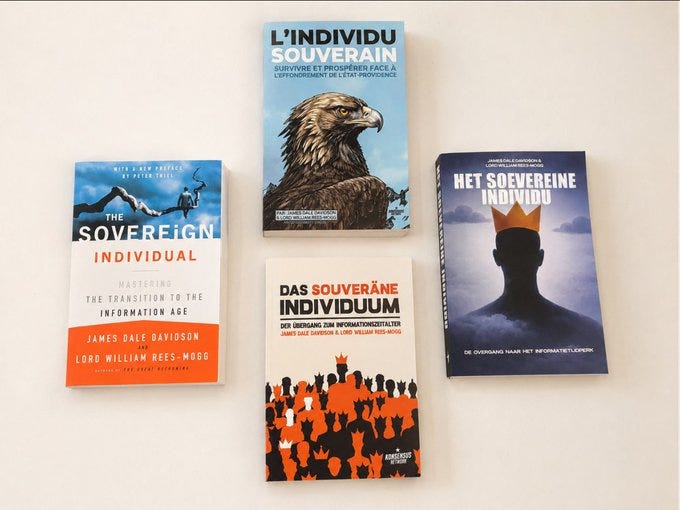
It unfolds in two movements: first the Hive, that single counter-world being built before our eyes, which promises to dissolve the individual into an administered marionette; then the Archipelago, the counter-proposal, with its tools, its defenses and its historical precedents. Paradoxically, in the short term, the sovereign individual needs the state today to survive, numerous and rival, for their competition is his only protection; in the longer term, he will have to build their successors.
The nation is a community of belonging, as old as the species. The nation-state will be revealed as a mere administrative construct for two centuries.
The Hive
The opening paradox
Today, this sovereign individual most often wears the face of a digital nomad. Jacques Attali sketched the portrait well ahead of time: a sovereign individual belongs to the caste of “hypernomads” Attali theorized as early as L’Homme nomade,² about a globalized, unattached elite that circulates wherever it is treated best. This nomad, good libertarian that he is, likes to imagine himself as the enemy of the state. He is in fact one of its very first beneficiaries, not of this or that state, but of their multitude. His entire power comes down to one word: mobility.
Where the captive citizen submits to the jurisdiction he was born into, the mobile sovereign practices arbitrage. He sleeps in Thailand, invoices from Dubai, structures his wealth in Singapore and keeps his original citizenship for a rainy day. Every state then becomes a service provider that must court him on taxes, safety, quality of life and legal stability, so that the individual quite literally goes shopping among nations.
That is the whole meaning of voting with your feet as Olivier Roland defends it in Tout le monde n’aura pas la chance de quitter son pays³, where you stop trying to reform the country that stifles you and simply leave it. A market only works so long as several sellers remain in competition, and the day the competition disappears, the man who was treated as a customer instantly becomes a subject again.
Albert Hirschman formalized it as early as 1970: when an organization deteriorates, there are only two recourses, voice and exit.⁴ Voice only counts as long as the door stays open, and the Berlin Wall shut it: A state that forbids leaving no longer needs to listen.
It is precisely the multiplicity of jurisdictions that protects the sovereign individual, not their disappearance.
The mobile sovereign’s first reflex, however counter-intuitive it sounds, should therefore be to wish the nation-states a long life, not out of love for any one of them, but because their sheer number is his only rampart so long as he has built nothing else.
This is not mere speculation; if historians are to be believed, it is the very recipe of the “European miracle”. Ralph Raico attributes Europe’s singular rise to its political fragmentation: that dust of kingdoms, principalities, free cities and rival republics where the prince who squeezed his merchants, his craftsmen and his scholars too hard watched them flee next door with their capital ⁵
Europe did not become free and prosperous despite its fragmentation; it became so because of it.
Here we touch the great misreading of the most naive libertarians, those who dream of a world finally rid of states. Power abhors a vacuum. A world without states is not a world without power, it is a world into which something else rushes: an empire, a cartel, a mafia or a handful of magnates.
And a world reduced to a single power, whatever name it gives itself, is a world without a single exit. Once no way out exists, no lever of negotiation remains, only a voice that weighs nothing because it can no longer be followed by a departure.
The single-counter trap
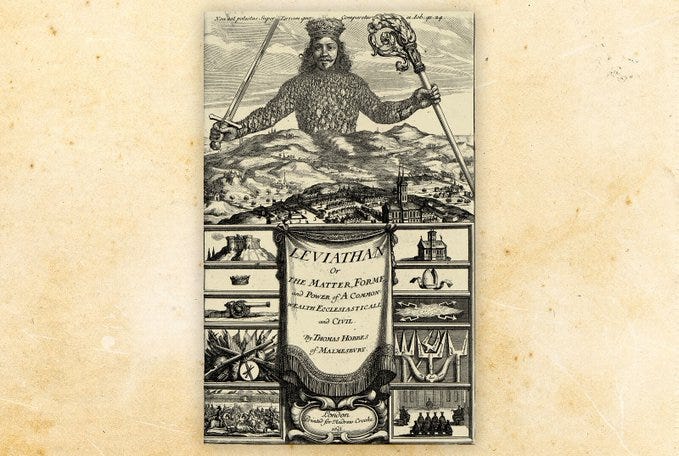
Frontispiece of Thomas Hobbes’s “Leviathan” (1651): the single sovereign, composed of the multitude.
The century’s real threat therefore does not go by the name it is usually given. It is not the states themselves that must be feared, but their disappearance into the single counter: the world where every jurisdiction posts the same rules at the same price, so that all of humanity stands in line at one and the same window. At a single counter, you no longer negotiate; you fill out the form in silence.
Picture the project’s culmination, a harmonized world governance, a Tower of Babel 2.0, and you will see it is no fantasy, for it is openly claimed. Attali has long pleaded for a form of planetary government:
One can imagine, one can dream of a Jerusalem becoming the capital of a planet unified, one day, around a world government. It is a lovely place for a world government.⁶
Klaus Schwab, for his part, theorizes in The Fourth Industrial Revolution that the fusion of the physical, digital and biological spheres will lead to a technology that no longer stops at the doors of the human body.⁷ In that world, the same tax rules would take hold everywhere, and with them the end of all competition between nations.
A standardized digital identity and biometric surveillance, a programmable currency for a directed economy. Governance by mandatory protocols, updated remotely and enforced automatically. And above it all, a global artificial intelligence able to watch, score and correct the behavior of billions of individuals in real time.⁸

An eye without a lid, open on every life.
Jurisdictional arbitrage would lose all purpose, because every counter would post the same price set by the same operator, and the mobile sovereign would suddenly discover that he has nowhere left to go — his mobility, his one true asset, is abruptly worth nothing. On top of this leveling of the rules would come something deeper and sadder still: the slow dissolution of the sense of belonging. A perfectly homogeneous humanity ceases to be a mosaic of peoples and becomes an administered mass.
Babel, inverted
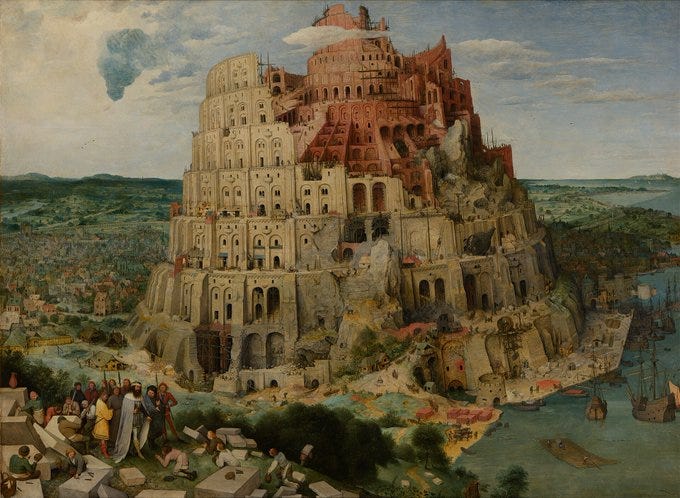
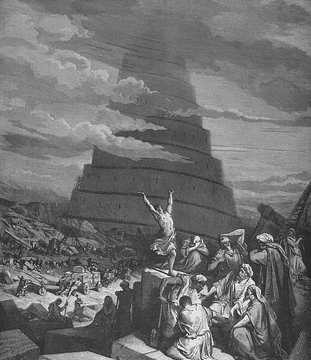
The Tower of Babel and the confusion of tongues.
This project bears a very old signature, one worth learning to recognize. In The Book of Genesis, men speak one and the same language and set out to build a tower that would reach the heavens, so as to “make themselves a name” and never be scattered again.⁹ The answer they receive is not lightning, but the confusion of tongues and the dispersion of the peoples across the whole face of the earth. That part is usually understood as a curse.
What if dispersion was never the curse we took it for, but the safeguard? World government, which would be the crowning of the deep states’ project, is today resuming the building site abandoned on the plain of Shinar. The same dream of unity, the same promises of stability and power, and a single language recovered at last, no longer some primordial idiom but code: all the apparatus described above, crowned by a global artificial intelligence that speaks, translates, watches and decides in a universal language from which no one will be able to withdraw.
The irony is that instant machine translation literally undoes the miracle of the confusion of tongues: the anti-Babel is technically operational. But look closely and this Babel 2.0 is a Babel inverted, and the inversion is fourfold:
The first tower was built by a humanity already one, refusing to scatter; the new one is being built to reunify a scattered humanity, that is, to retroactively abolish the very gesture that had put it out of harm’s way.
The first rose from the earth toward heaven; the new one descends from the “cloud” onto men, through successive updates, regulatory capillarity and terms of service.
The first was raised by an entire people for itself; the new one is erected by a caste for everyone else, a tower whose builders will not live on the same floors as those they house in it.
The first, finally, was interrupted from above and its builders scattered; no one will come to interrupt the second, which seeks only to uproot men so that none may stand apart any longer, and at its summit no longer sits God, but those who dream of becoming Him.
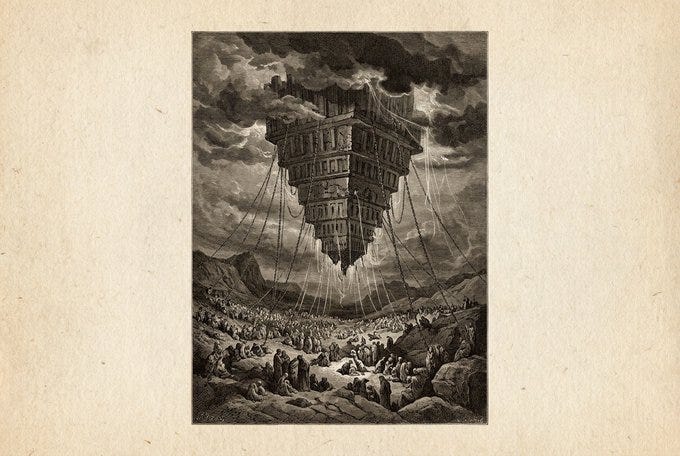
Babel 2.0: the tower that descends from the “cloud” onto men.
Building the Archipelago therefore amounts to nothing other than repeating the gesture of dispersion, but voluntarily this time, preferring the multiplicity of languages, rules and communities to the false peace of a single command. United, but in dispersion.
The dream of the hive queens
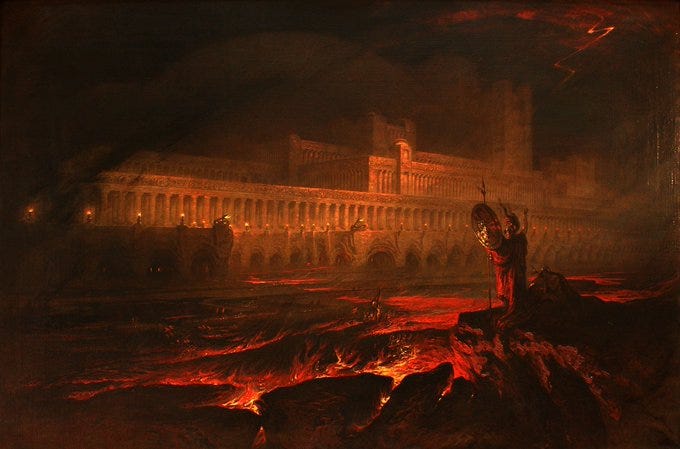
John Martin, “Pandemonium” (1841): Better to reign in Hell, than serve in Heaven.
To measure the real stakes, one must stop reasoning by names and start reasoning by mechanism: it matters little who sits at the controls, what counts is the structure that makes the interests converge. What the promoters of world governance are preparing, each in his own way, is not an abstract battle of ideas but the installation of a system in which power accrues mechanically to those who already hold the dominant position, and more still to those who hold the data.
Whoever holds the data holds asymmetric knowledge of every individual, of his desires, his fears, his weak points and his next move. Yuval Noah Harari says it bluntly:¹⁰
Those who own the data own the future.
Whoever owns the data acquires over each individual a power that, as Harari repeats at Davos, neither the Gestapo nor the KGB ever possessed: a power no king has ever held.
This asymmetry would not stay theoretical for long, for it already has its tooling and even its full-scale prototype. Couple surveillance, digital identity and digital money to a social credit system, and you get what China is already running in still-fragmentary form: the capacity to reward conformity and punish deviation, no longer through prison but through exclusion.
One Ring to rule them all, One Ring to find them, and in the darkness bind them.¹¹
The non-conforming individual would not be imprisoned but unplugged, cut off from credit, housing, transport, work and social life.
Not repressed: slowly rendered unviable.
There is no life in the void… only death.¹¹
The unplugged man has neither dungeon nor executioner; he has the void, and the void erases him.
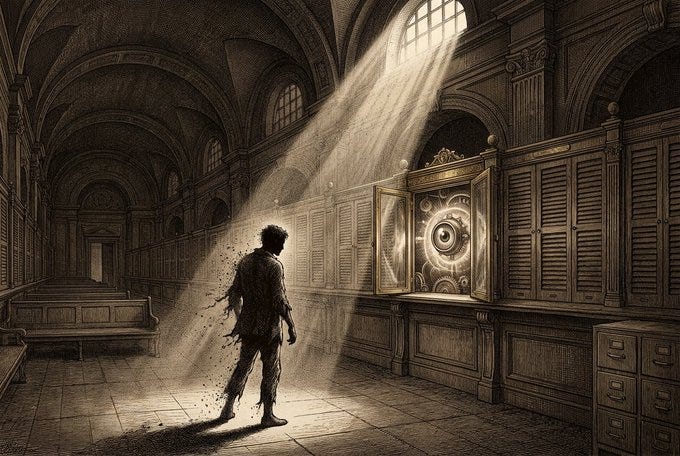
The unplugged: neither judged, nor punished. Erased, rendered unviable.
This is where social control joins, through a back door, the old eugenicist project, with this difference, that it no longer selects for strength but for obedience. An individual excluded economically and socially is an individual who starts no family, does not reproduce, and imparts nothing.
At scale and over time, a system that methodically unplugs the non-conformists ends up exerting a selection pressure in favor of obedience alone, without anyone ever decreeing anything: make conformity the condition to access a normal life, and the selection runs itself.
Laurent Alexandre describes the other face of the same fracture, a cognitively augmented elite gradually separating from the rest of humanity,¹² and it is the very schism Harari foresaw in announcing the advent of a Homo Deus, that man-god for whom augmentation, longevity and machine intelligence tear from the common condition and raise above a “useless class” left without work or power¹³.
The hive thus produces not one humanity, but two: a caste that transcends, and a mass that is administered.
There lies the real stake of this turning point, and it is not jurisdictional arbitrage: will the human being remain an end in himself, or become a resource managed by those who already take themselves the hive queens? To this Homo Deus the elite dreams of, the Archipelago opposes not another master but something else entirely: a man who does not seek to become a god, only to remain a free man, master of himself, what Roman law called sui iuris.
It is hard not to think of La Fontaine. The well-fed dog praises his bowl to the starving wolf, until the wolf notices the worn patch on his neck:
Chain! Chain you! What! Run you not, then, just where you please, and when?
The hive is a bowl that never tips over, at the price of a collar that never comes off.
So ran Sir Wolf, and runneth yet.¹⁴
Accept domestication, or return to the wild: the dilemma of a century is already contained in the fable.
The unsettling face-off between Peter Thiel and Leo XIV
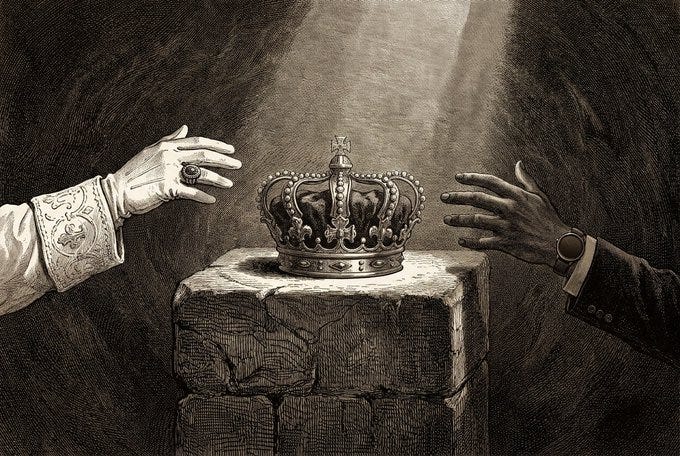
After all, why not? Why shouldn’t I keep it? Bilbo, The Fellowship of the Ring (2001)
At the gates of the Vatican, a pope and a tech billionaire are fighting over the future. Leo XIV devotes his encyclical Magnifica Humanitas to the threat artificial intelligence poses to human dignity;¹⁵ Peter Thiel has just delivered his series of lectures there on what he calls the politics of the Antichrist.¹⁶ The Pope sees the danger in the machine that no one controls; Thiel sees it in the control of the machine, that world government which would come to save us by promising security.
But they share the one diagnosis that matters: real power has already organized itself into transnational networks that reach beyond governments; the era of the nation-state is ending, and the question is no longer whether a power above the nations will come, but who will wield it.
Each proposes his own thesis.
The Pope, first, reads the century through the same lens as this text. His encyclical opens on two icons: Babel, the uniformity of a humanity that wants nothing above itself, and Jerusalem, the city rebuilt after the exile in Babylon “through the shared responsibility of all”.¹⁷ And he warns:
When these goods remain concentrated in the hands of a few, without adequate forms of sharing and access, a new imbalance is created.¹⁸
But his remedy changes scale: a world governance of artificial intelligence, a refounded multilateralism, reformed international institutions,¹⁹ and the Church as moral compass of the whole. It is the old world’s survival plan: the governments of the earth fused into one body to rebuild Jerusalem, as one man, that city which his own encyclical recalled no man alone had raised. A pope who blesses that building site is also preaching for his own parish.
Attali, who dreams out loud of Jerusalem as capital of the world government, has merely said bluntly what the Pope’s remedy whispers. Thiel, for his part, holds that remedy to be the supreme trap: the Antichrist will not seize power by unleashing the apocalypse, but by brandishing it without respite, promising peace and security in exchange for the surrender of all liberty, and keeping at the controls the institutional dinosaurs technology was supposed to send into retirement. The argument is powerful.
It is also an outsider’s argument: a world without a shared framework does not remain masterless; it falls by default to those who already hold the data and the servers, that is, to his own caste.
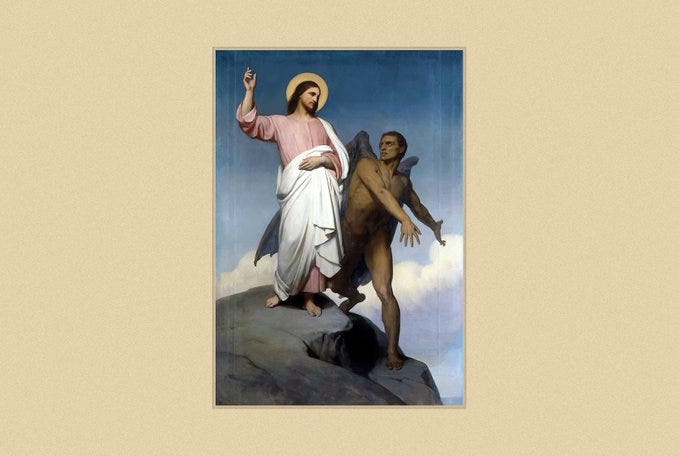
Ary Scheffer, “The Temptation of Christ” (1854). All the kingdoms of the world, if you bow down. Jesus remains the only candidate to have declined.
Set one world government beside the other: the Pope’s would be official, a seat, a flag, treaties; the data lords would need none of it. It would govern without being elected, or even appointed. The man who preaches against the Antichrist has, after all, named his surveillance company Palantir, after the seeing-stones of The Lord of the Rings — instruments of kings, of which the legend keeps a single lesson:
Whoever thinks he is using one is already being watched by an eye greater than his own.¹¹
Where the Pope sees in world governance the remedy to be built, Thiel sees the throne not to be left for the taking. This is where we part ways with both. For each betrays what he claims to defend: the Pope rebuilds the first Babel by trying to rebuild Jerusalem; Thiel builds the second, the one that descends from the cloud, forging for the Antichrist the very tools he claims to ward off.
Two doors, one hive. This great duel has, at bottom, the look of a two-party system: two colors that clash on everything, except on what matters. They fight over the wheel, never over the destination: a power above the nations, whether it sits in a Jerusalem of marble or in a cloud of servers.
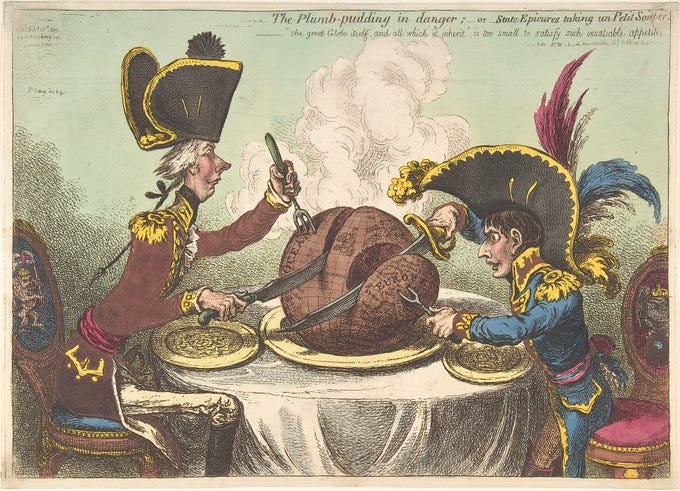
James Gillray, “The Plumb-pudding in Danger” (1805). The great Globe itself is too small to sate such appetites.
World governance, a chimera?
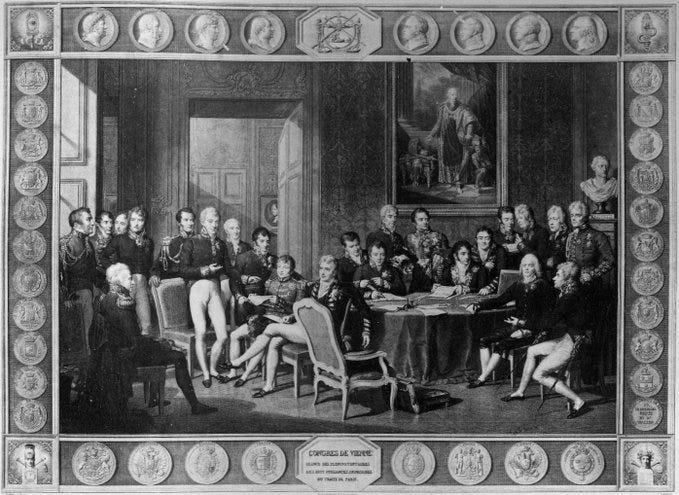
Jean-Baptiste Isabey, “The Congress of Vienna” (1815). The world is redrawn around a table. The peoples are not in the room.
This face-off is nonetheless only the visible tip of a far older movement, and one would be gravely mistaken to take it for a quarrel of today. Governance above the nations is not a hypothesis about the future; it is a building site opened in 1945, rising layer upon layer, and every floor of which was presented, in its time, as the reasonable answer to a very real crisis.
There was the states’ floor first. At Yalta, three men divided the fate of peoples without ever consulting them. Then came the Bretton Woods agreements, the United Nations and the building of Europe stacked, treaty upon treaty, an authority no voter ever overturns.²⁰ This design is readily taken for the fantasy of anxious minds, yet it is now on display brazenly: in September 2024, the states gathered in New York adopted a pact whose ambition the United Nations itself sums up thus.
Transforming global governance.
United Nations, Pact for the Future, 2024²⁰
Then comes the floor of synchronization, and it is the most troubling, for no order need be given there for everyone to comply. Covid was the dress rehearsal, with governments the world over adopting within days of one another the same lockdowns, the same health passes, the same closures. The World Health Organization has since had amendments and an agreement voted through, in 2024 and then in 2025, establishing a planetary pandemic alert and coordinating the response in advance, to the point that the United States formally rejected them to preserve its sovereignty.²¹
The same choreography is playing out today over speech and online access: age verification, restriction of social networks, removal of content, voted within months of one another in the United Kingdom, Australia, South Korea and Canada. The European Union, for its part, has been pressing bill after bill since 2022 to impose the scanning of our private messages, including encrypted ones.²² None of this presupposes a conspiracy or a hidden hand: it is the very nature of a convergence, and a convergence has never needed a conductor for everyone to play the same score.
There remains the most advanced floor, that of money, and it is the one that touches us most closely. A global minimum tax, agreed by more than one hundred and forty countries, has been hitting large companies since 2024, and from 2026 your cryptocurrency accounts will be recorded and exchanged from one tax administration to another, including transfers to your own wallets.²³ And if we are assured that the digital euro will not be “programmable” as the yuan already is, the general manager of the Bank for International Settlements had said out loud the truth of the instrument:
The central bank will have absolute control on the rules and regulations that will determine the use of that expression of central bank liability, and also we will have the technology to enforce that.
Agustín Carstens, Bank for International Settlements, 2020²⁴
The United States, for their part, need not even wait for their own digital currency: they already hold it, under a name that disguises it. The stablecoin, that private token pegged to the dollar and readily presented as an emancipation, is most often nothing but a dollar backed by American debt, traceable and freezable at a distance by whoever issues it. Its leading operator now ranks among Washington’s largest creditors, and freezes an account at the simple request of that administration.²⁴
The programmable dollar therefore exists; it already circulates across the entire planet, and it never needed a central bank for that: everyone, often without knowing it, is using the control currency of a state that is not their own.
What remains is to move from the rule to the example, and a power that wants to make an example no longer even needs a prison. In 2022, Canada froze hundreds of bank accounts without a single judge, for the sole offense of having supported a protest, a measure its own courts have since ruled unlawful.²⁵ Unplugging is therefore no hypothesis: it has already happened, in a G7 country. The only ones who escaped the freeze were those holding a currency whose keys no one held in their stead, but we are not there yet.
All these actors are fighting bitterly over the form this power will take. The states want to keep the wheel; the data lords want to govern through protocols; the institutions want to codify the rule; the networks in the shadows want to pull the strings unseen. None of them, however, contests the substance, and all are busy (each in his own way), raising the same tower and taking a seat in the same Jerusalem. That a power should install itself above the nations is no longer a question but a due date, and the only divide that still counts does not separate its supporters from its opponents; it separates those who want to steer it from those who intend to escape it.
The Archipelago is neither world government nor the magnates’ unshared reign. It is the third way neither of them dares to name: a sovereignty distributed, consented to, and always revocable. Perhaps that is what it means to rebuild Jerusalem without waking Babel: each to his own stretch of the wall.
The Archipelago
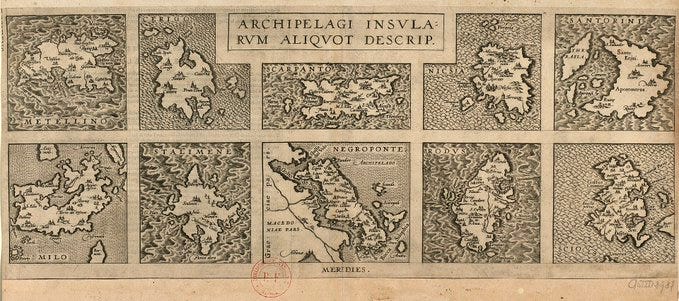
Abraham Ortelius, “Archipelagi insularum aliquot descriptio” (1584). Before it named every island chain on Earth, the “Archipelago” was first a proper noun: the Aegean Sea and its islands.
Nationhood by choice
Let it be said clearly: this is in no way a plea for a nostalgic return to the old nationalism, the twentieth-century kind that rested on the accident of birth, the imposed border and forced belonging, and which died without cause for regret. The nation, as stated from the outset, was never reducible to the nation-state. What I am describing is its exact inverse: a neo-regionalism founded on choice, that is, highly aligned communities that voluntarily decide to become nations, defined by three non-negotiable properties.
Membership is voluntary: you join because you share values, a project, and a vision, never by the accident of birth.
Exit remains easy, and that ever-open door forces the community to earn your presence every day.
Competition between them is permanent: these communities vie for talent and capital, which compels them to improve or disappear.
One recognizes here the market of jurisdictions, but rebuilt voluntarily from the ground up, where the old world imposed it from above.
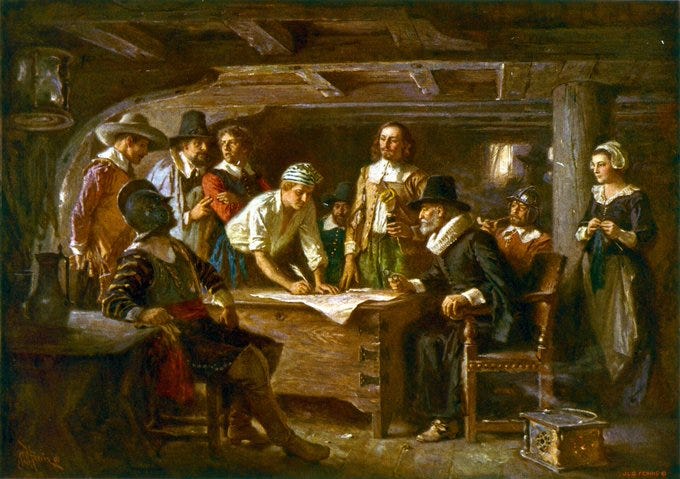
Jean Leon Gerome Ferris, “The Mayflower Compact”. Before going ashore, the colonists sign the covenant that will govern them: the rules first, the soil second.
Some will object that a community without coercion also attracts its free riders, those who consume the Archipelago without ever building it. But the open door swings both ways: a community you may freely leave is also a community that remains free not to keep you. In the Hive, the parasite is unplugged by the algorithm; in the Archipelago, he is neither judged nor punished: his membership is simply not renewed. Belonging there is earned in both directions, every day, by what you bring.
A more serious objection then rises, and it would be dishonest to dodge it: this mobility, this capital and this ability to choose one’s nation are first the privilege of those who already have the means, so that the Archipelago would look like a closed club for the happy few while the mass remained captive of the single counter. The remark is fair, but it aims at the wrong target.
This project does not claim to save everyone by decree from above: that promise of salvation administered and distributed to all is precisely what defines the Hive.
The Archipelago proposes the exact inverse: an open invitation to build rather than a favor granted. Its first inhabitants will necessarily be those who can move and fund the start, like all the pioneers and all the diasporas before them; but what they erect—laws, tools, legal precedents and a membership that remains open—is also what lowers the barrier for those who come next.
The real danger is not that the Archipelago might exclude part of humanity, but that no one builds it, for then it is humanity entire that will wake up inside the Hive. Those with the means to open an exit therefore inherit not a privilege but a responsibility: that of not being the only ones through it. That is precisely what separates the Archipelago from the reign of magnates we feared in Thiel.
A nation founded by first-comers degenerates into oligarchy only on the day its door closes; a power you can leave at no cost, exposed to the permanent competition of other communities that want nothing more than your talents, instantly ceases to be a power over people and becomes no more than a service they choose to renew.
The forgotten precedent: the diasporas
None of this is a technologist’s utopia: history has already produced nations without territory that survived where entire empires collapsed, those nations we call diasporas.
The Jewish people maintained for nearly two millennia an identity, a law, a language and a tribal solidarity woven into dense networks of mutual aid across the world, without possessing a state; driven from one country, it replanted itself in another, and expelled from Spain in 1492, it rebuilt in Amsterdam, in the Ottoman Empire and wherever a door remained open.
The Lebanese diaspora likewise wove merchant networks running from West Africa to Latin America, prospering far from a country too small and too unstable to hold it. After 1917, an entire Russian elite drifted from exile to exile carrying its culture with it, and the Armenians, like the overseas Chinese, tell at bottom the same story.
A distributed nation, made of people and wealth spread over several soils, cannot be beheaded: when one place turns hostile, capital, skills and families flow back toward the safer nodes of the network. Resilience does not come from a territory; it comes from dispersion itself, and once again we find a Tower of Babel turned around, dispersion as a survival strategy rather than a curse.
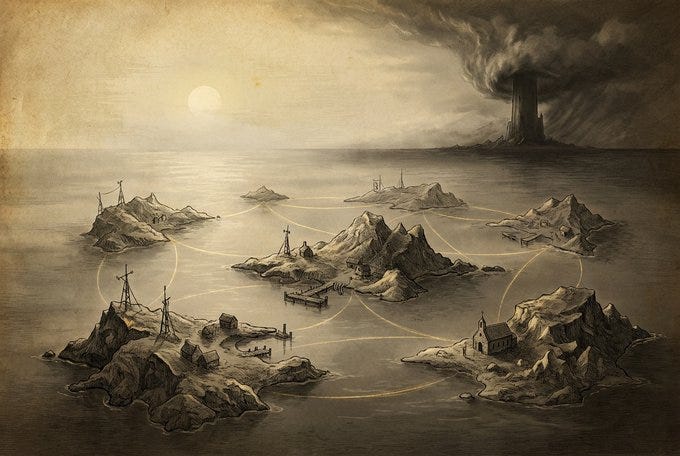
The Archipelago, alive, free and wild. The Hive and domestication on the horizon.
The cement of those diasporas was a sense of belonging, most often religious or national. The network state, the nation constituted as a network, extends the inheritance without repudiating it: that cement can remain what it was, or become a chosen alignment, made of values, a vision and a shared project.
One crucial thing separates the network state from its forerunners. The forerunners were thrown into wind by persecution, expulsion, or the collapse of their country, whereas the network state has emerged as an immune reaction to compulsive inclusion in the great centralization. It proposes to capture the diaspora’s resilience without enduring its pain: to do by choice what those peoples had to do by necessity, substituting voluntary dispersion for dispersion endured.
And with that falls the objection we hear invariably, that no strong sense of belonging could survive mobility: the diasporas have been answering it for nearly three thousand years.
Belonging has never needed soil to exist; it is carried whole in people.
Technology overturns the asymmetry
Dispersion still has to be materially possible today, and here comes the only genuinely good news. For centuries, capturing a center of power required colossal means, an army, a central bank, a printing press, a network of spies and an entire state apparatus, which reserved the game for a handful of players and condemned the individual to the role of subject.
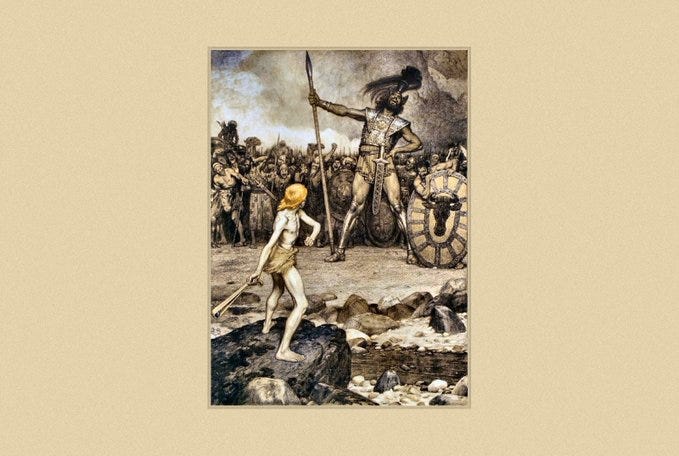
Osmar Schindler, “David and Goliath” (1888). Goliath had the size, the armor, and the army. David had a sling.
It is this asymmetry that technology is now breaking, shifting the center of gravity of power toward the individual, for whoever cares to seize it:
Encryption makes communication and coordination inviolable, and thereby lifts organization out of surveillance’s reach.
Bitcoin strips the state of its monopoly on money and makes possible a common currency that no one can freeze or dilute.
Self-hosted artificial intelligence puts a cognitive power once reserved for large institutions within reach of individuals and communities of any size.
3D printing makes the manufacture of weapons and security equipment hard to control and breaks the dependence on traditional supply chains.
Each technology leans one way. Peter Thiel said it in a formula that stuck:
Crypto is libertarian, AI is communist.²⁶
Cryptography and Bitcoin scatter power toward individuals; centralized artificial intelligence concentrates it in the hands of those who hold the data and the servers. The century’s fight plays out between these two slopes, and nothing obliges us to let the second one win.
Bitcoin, or the return of thermodynamics
Of all these bricks, Bitcoin is the most decisive, because it settles the choice between two opposite definitions of human usefulness. The Hive queens’ project rests on a currency created out of nothing, where whoever prints decides who receives, and therefore who prospers. The word “useful” no longer refers to anything objective: the useful man is the compliant man, the one whom social control, credit and permissions designate as deserving, usefulness reduced to a political favor handed down from above to those who submit.
Bitcoin overturns that logic entirely. Its scarcity is absolute and mathematical, fixed at twenty-one million units and not one more, and its issuance is anchored to a real expenditure of energy, which puts thermodynamics back at the center of the game: you do not cheat physics, and you do not conjure value with a snap of the fingers.
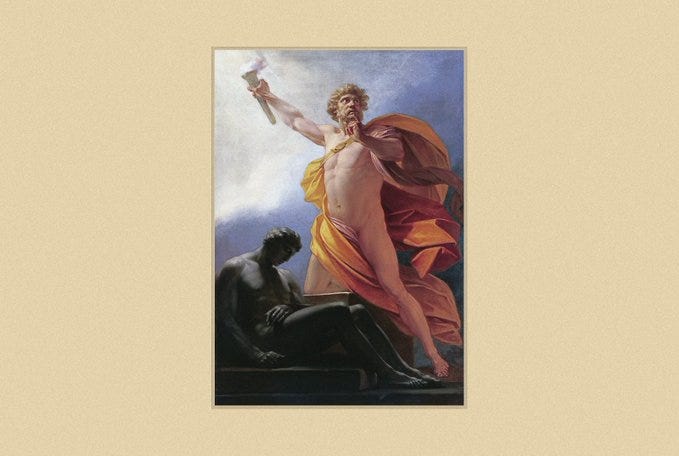
Heinrich Füger, “Prometheus Brings Fire to Mankind” (1817). Fire taken back from the gods, a finger to his lips: some powers are reclaimed without permission.
It is the return of the hard money Saifedean Ammous showed accompanied every flourishing civilization.²⁷ In an economy anchored to a currency no one can dilute or freeze, an individual’s usefulness is no longer decreed but revealed by the market: useful is he who produces what others freely choose to pay for. Selection ceases to be political and becomes natural again, and you survive there because you truly serve, not because you conform.
That is what separates proof-of-stake from proof-of-work: under the first, those who already own decide, and wealth votes for itself. Under the second, the rules are the same for everyone. But this money still has to be truly yours, and not a credit line with someone you are forced to trust, which is what Bitcoin’s builders like Francis Pouliot (
) call The Hard Path.²⁸ Sovereignty is never a comfort you buy; it is a discipline you learn and hold.
It is in this economy of proven, not decreed, usefulness that the sovereign individual takes shape: the man whose worth no longer depends on a favor granted from above, but on his work and on what he actually brings to his own. In the Hive you are deemed useful when you obey; in the Archipelago you survive only if you truly serve, and the whole distance between the two worlds lies in that single shift.
First digital, then physical
The mutation will begin in the digital realm, because that is where the cost of organization is lowest: online communities, commerce settled in Bitcoin, portable reputation. It is what Balaji Srinivasan (Balaji) , who gave the movement its manual with The Network State, sums up in the formula “cloud first, land last”, taking care to add: but not land never.²⁹
A purely virtual nation remains at the mercy of the physical world, exposed the moment the power is cut, or the servers are seized, and digital sovereignty without material anchorage is never more than a comfortable illusion. Neo-regionalism will therefore have to come back down into the real, in the form of distributed territories, autonomous energy, food production, concrete skills and a genuine capacity to hold when comfort stops.
The endpoint is not perpetual nomadism; it is chosen re-rooting. Nomadism was only a stage: the land you choose and work remains the destination.
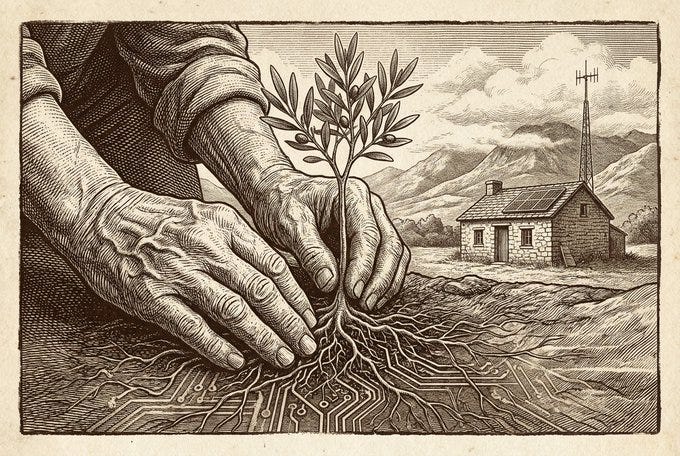
Putting down roots again.
Defense, first stage: the technological barrier
Then comes the objection everyone raises, and rightly so: how could a small voluntary territory defend itself, when it will never have an army or a monopoly on violence the way a classical state does?
Two tiers of threat must be distinguished here, because they do not call for the same answer. The first is low-level physical menace, banditry, opportunistic predation, and the chaos that follows a collapse. To that one technology answers, not by force in the classical sense but by asymmetry, through a barrier to entry that makes any aggression economically absurd:
3D printing produces and repairs the weapons, parts, tools, and equipment on site, with no supply chain to cut and therefore no chokepoint to exploit against you.
Drone swarms provide permanent perimeter surveillance, deterrence, and an autonomous response capacity, where an entire garrison once had to be mobilized.
A local artificial intelligence handles intrusion detection and threat anticipation, all of it self-hosted, with no dependence on a foreign cloud that might betray you one day.
You do not defend a network state the way you would defend a citadel; you simply arrange for it to become too costly to subdue.
The prototypes already exist, fragilities included
This is not science fiction: the first prototypes are already out of the ground. Balaji Srinivasan defines the network state as “a highly aligned online community with a capacity for collective action that crowdfunds territory around the world and eventually gains diplomatic recognition from pre-existing states”³⁰. Próspera, in Honduras, an economic zone under private governance, stands as a first prefiguration, along with Bitcoin Jungle in Costa Rica, built around a circular Bitcoin economy and a re-rooted way of life.
But one must be honest where the dream-sellers are not: these prototypes remain fragile. Próspera exists only at the pleasure of its host jurisdiction, and experience has shown that a change of government could put its existence in question overnight.³¹ That is exactly the dependence the next generation will have to learn to outgrow, not by imitating these pioneers, but by drawing the lesson of their Achilles’ heel.
Defense, second stage: surviving the host
The most serious threat is not military but legal, and no drone swarm has ever stopped a parliament: what nearly killed Próspera was not an assault; it was the repeal, by a simple vote, of the law that allowed it to exist.
The real question, then, is how a voluntary territory survives the day its host state revokes with a stroke of the pen the right it had granted. Since a host cannot be prevented from repealing a law, defense does not consist in making yourself unattackable, but in making your revocation undesirable.
Which draws four lines of resilience.
Be wanted, not merely tolerated
It was not an attack that nearly carried Próspera away; it was a political rejection: perceived as a foreign enclave, dropped onto the territory without its people, it offered the ideal target when a government went looking for a convenient enemy, and no one in the local population had the slightest interest in defending it.
The first line of defense, then, is not a drone; it is the desire of the population that hosts you.
A network state that brings its region hospitals, schools, jobs, roads, energy, and prosperity becomes politically untouchable, because repealing it would mean, for the power in place, turning its own voters against itself.
You do not protect yourself against the host: you make its population your best ally. Bitcoin Jungle, in Costa Rica, took the path opposite to Próspera’s: rather than planting an enclave, it bitcoinized the economy that was already there, the shopkeepers, the guides, the fishermen of the Costa Ballena, so that there is no enclave to defend: the community and the population are one.
Never depend on a single host
It is the arbitrage this text began with, applied no longer to the individual but to the whole community. Rather than betting everything on a single Honduran law, you negotiate special statuses, free zones, exemptions or charters, with several jurisdictions at once, in such a way that the network owns very real property, but spread over ten soils instead of one.
When a node turns hostile, people and capital flow back to the nodes still safe, along fallback plans prepared in advance: a repeal no longer kills the nation; it moves a node. What is truly distributed cannot be beheaded with a rubber stamp.
Aim for recognition, not territory
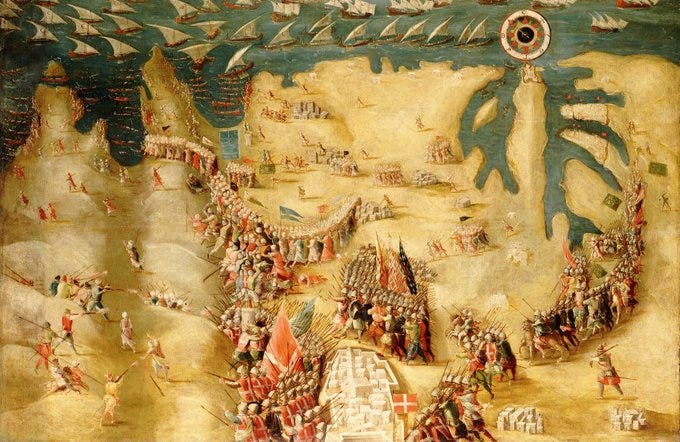
Matteo Perez d’Aleccio, “The Flight of the Turks” (1565). The Order would lose the island in 1798, but not its sovereignty.
This is where the most instructive example comes from an institution nobody expected: the Sovereign Order of Malta, heir to the Hospitallers, which lost its last territory in 1798 when Napoleon drove it from the island of Malta, and which remains nonetheless, more than two centuries later, a full subject of international law.
It maintains full diplomatic relations with one hundred and fourteen states, issues its own diplomatic passports, keeps its embassies and sits as a permanent observer at the United Nations, all without owning a single square meter.³² Its existence proves what states would rather we forgot: sovereignty does not proceed from land, but from recognition.
That is exactly the endpoint Balaji assigns to the network state, since an entity that patiently accumulates bilateral recognitions and treaties ends up becoming a subject of law that no single host can erase without paying a diplomatic price. The sequel to the Próspera affair confirms the lesson: it is before an international arbitral tribunal, armed with a free-trade treaty, and not behind walls, that the city is fighting today for its survival.³¹
Keep the soul in the cloud, the body on lease
All of this comes down, finally, to understanding the formula “cloud first, land last” in its full scope. The heart of the nation, its system of values, its identity, its governance, its capital, its intellectual property and its human network, lives in a portable layer no host controls; the physical territory is only ever its body, precious to be sure, but replaceable. If a host revokes, you lose a body and never the soul: the capital, the code and the network replant themselves elsewhere within months, and under another charter.
Resilience is not born of a place’s inviolability; it is born of the portability of the essential.
The true defense of a network state is not to make it impregnable, but to make it indispensable to those who host it, too distributed to be beheaded and too recognized to be erased.
The uncomfortable mirror: Network State and deep state
There remains a parallel that disturbs, and that must nonetheless be faced squarely: the network states of tomorrow share part of their DNA with the deep states of today. What is a deep state, really? Not an elected government, but a network of influence that dictates the laws by capturing the centers of power, across borders and without ever answering to the territory it sways from the dark.
And that describes, trait for trait, the structure of a network state: a de-territorialized entity, organized as a network and able to bear on the real world without being a state in the Westphalian sense.
The difference between the two lies not in the method, but in consent.
The deep state captures power in order to take it from individuals, in opacity and without their agreement. The network state organizes in the open to give it back to them, on the basis of revocable membership. The first resembles a parasite thriving in the dark; the second, an organ you choose to join and remain free to leave. It is, in the end, the same technology of power, simply turned around, and that reversal lets it work as a counter-power: it takes a network to fight a network.
A murmuration, not an empire
These islets would not, for all that, live in isolation. Linked by encrypted communications, tactical collaboration, and trade, they would run on two registers at once, like any living ecosystem: in collaboration first, through common protocols, interoperability, and mutual aid in the face of the existential risks artificial intelligence amplifies; in competition second, to attract talent, capital, and attention.
In the era ahead, it is this murmuration of entities that will act as the counter-power to a deep state that has completed its project, for they are designed to survive the steamroller of Babel 2.0, right where the global artificial intelligence would become the ultimate weapon of homogenization.
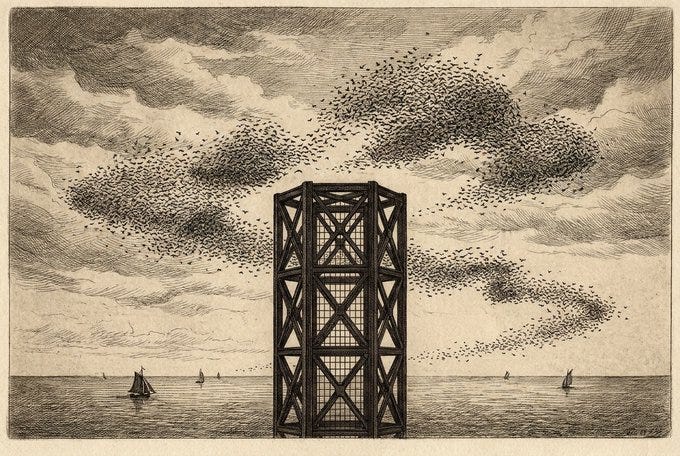
The murmuration against the monolith.
Mutation, or voluntary servitude
So it must be said plainly: the sovereign individual, to remain one, cannot stop at the digital nomad stage. That stage, however useful for the learning, the capital and the experience it allows one to accumulate, remains dangerously transitional, and the nomad who believes he has found definitive freedom there has only enjoyed a window: the one during which the counters still compete.
That window is closing. The day it shuts, the nomad left without anchorage will no longer be a free man but the captive customer of a planetary monopoly, paying his taxes to the last operator standing and scored by the only artificial intelligence still in service.
He will therefore have to mutate, and fast, failing which he will become, despite himself, the most zealous worker of the global monopoly he claimed to flee. The states that protect him today by their rivalry will be absorbed one by one, and on the day the last one falls, the only survivor will be the man who, with his peers, has rebuilt a nation.
The real choice is not between liberty and the state. It plays out between building the nations of tomorrow and enduring the last one left, and that is, at bottom, the only anthropological turning point that truly matters: to become builders again, or to end as cattle.
Return to the wild, or accept domestication.
La Boétie understood it nearly five centuries ago, he who was astonished that millions of men should serve a single master who has no power but the power they give him:
Resolve to serve no more, and you are at once freed.³³
The Hive will not need to chain us if we ourselves choose the comfort of the cell. It is even counting on it. On that choice, and on it alone, depends what will remain: men who are masters of themselves, or agents of the Hive.
In the Archipelago, you fly the drones; in the Hive, you become one.
And it must be said with the same frankness: that kind of sovereignty will never be a given. It is not a status you obtain, a passport you buy or a citadel you finish; it is a discipline that is held and earned every day, a quest that does not end, and that may be its very beauty: you are never sovereign once, and for all; you never stop becoming sovereign. The diasporas learned this over nearly three thousand years. The builders of the Archipelago will have to learn it again in their turn.
The Hive promises security, automatic belonging and administered salvation, and it will probably keep its word, at the exact price of what makes a man a man.
The Archipelago promises nothing: it invites, it tests, it disperses, it begins again.
Between the tower descending on men so that none may escape it and the scattered islands one lands on freely, the century ahead will decide, and each of us with it.
Dispersion was the first gift ever given to men who wanted to make themselves a name. It is time to unwrap it again, by choice this time.
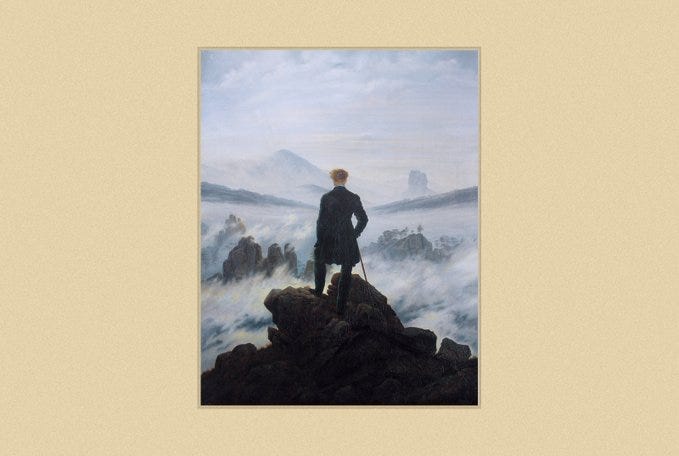
Caspar David Friedrich, “Wanderer above the Sea of Fog” (c. 1818).
Written by Science G. (@science_genial) for Le Bunker (@LeBunkerBTC).
Le Bunker publishes in French. Our free guide to shrinking your attack surface, and everything we build next, live at https://bio.lebunker.net
Sources and acknowledgements
This text was born of readings and conversations, some of them running late into the night, with Gégé, Ludovic Lars, Prapakhan, Lee of Bitcoin Jungle, Ulrich of the Café Viennois, Théo Mogenet, Francis Pouliot, Olivier Roland, Édouard of Konsensus, and many others. Thank you all. Thanks as well to everyone who took the time to read the first, much shorter version, and to those who will have taken the time to read this one in full. Finally, thanks to those who are building, day after day, everything this text has been talking about.
The illustrations without attribution were generated by artificial intelligence (Gemini, Nano Banana Pro); the others are in the public domain.
Notes
James Dale Davidson and William Rees-Mogg, The Sovereign Individual, 1997: “Governments will ultimately have little choice but to treat populations in territories they serve more like customers, and less in the way that organized criminals treat the victims of a shakedown racket.” French, German and Dutch editions published by Konsensus
Jacques Attali, L’Homme nomade, Fayard, 2003, untranslated. Attali distinguishes the “infranomads”, nomads by constraint, the sedentary, and the “hypernomads”, nomads by choice: executives, creators, financiers. The typology is taken up and expanded in Une brève histoire de l’avenir (2006), published in English as A Brief History of the Future (Arcade, 2009).
Olivier Roland, Tout le monde n’aura pas la chance de quitter son pays (“Not everyone will get the chance to leave their country”), untranslated.
Albert O. Hirschman, Exit, Voice, and Loyalty, Harvard University Press, 1970.
Ralph Raico, “The European Miracle” (1994), reprinted in The Struggle for Liberty (Mises Institute). It was fragmentation, and the permanent possibility of exile, that disciplined the princes of Europe.
Jacques Attali, interview on Public Sénat, 16 February 2010, in French. Our translation.
Klaus Schwab, The Fourth Industrial Revolution, 2016: “It is the fusion of these technologies and their interaction across the physical, digital and biological domains that make the fourth industrial revolution fundamentally different from previous revolutions.” Schwab devotes a section of the book to implantable technologies, whose announced tipping point is “the first implantable mobile phone available commercially”: devices, he writes, “are not just being worn, but also being implanted into bodies”.
Even without a formally global government, a simple convergence into blocs, an Atlantic sphere on one side, a non-aligned continental ensemble on the other, would produce the same trap at each individual’s scale: two or three counters that align on the standards that matter, identity, money, reporting, are hardly better than one.
Genesis 11:1-9 (King James Version): “Go to, let us build us a city and a tower, whose top may reach unto heaven; and let us make us a name, lest we be scattered abroad upon the face of the whole earth.”
Yuval Noah Harari, 21 Lessons for the 21st Century, 2018, lesson 4: “Equality: Those who own the data own the future.” The Gestapo/KGB comparison comes from his Davos address, January 2020: “Neither the Gestapo nor the KGB could do it.”
The Ring inscription: J.R.R. Tolkien, The Lord of the Rings. The voice of the void, however, is not in the book: it is Sauron’s line, written for Peter Jackson’s film (2001). The palantíri are Tolkien’s seeing-stones, of which no user escapes Sauron’s gaze; the maxim commenting on them here is not Tolkien’s.
Laurent Alexandre, La Guerre des intelligences (“The War of Intelligences”), JC Lattès, 2017, untranslated.
Yuval Noah Harari, Homo Deus: A Brief History of Tomorrow, 2016, where the notion of the “useless class” appears.
Jean de La Fontaine, “The Wolf and the Dog”, Fables, Book I, Fable 5 (1668), English translation by Elizur Wright.
Leo XIV, Magnifica Humanitas, encyclical letter on the protection of the human person in the age of artificial intelligence, 15 May 2026. Quotations follow the official English text.
Four private lectures delivered in Rome, 15 to 18 March 2026, a few hundred meters from the Vatican, on the figures of the Antichrist and the katechon.
Magnifica Humanitas, § 7-10: the twin icons of Babel and Jerusalem open the encyclical.
Magnifica Humanitas, § 67.
Magnifica Humanitas, § 64, 72 and 131. At § 64, noting the “crisis of multilateralism”, he calls for “ways of cooperating and of more effective international institutions, capable of safeguarding the global common good”. And at § 27, the Church assigns itself its place: she “must make her voice heard, not in order to dominate, but to promote communion”.
Yalta (February 1945), the Bretton Woods agreements (1944), the United Nations (1945), then the building of Europe. Pact for the Future adopted at the UN Summit of the Future on 22 September 2024, whose final part is entitled “Transforming global governance”.
Amendments to the International Health Regulations adopted in June 2024 (in force 19 September 2025, establishing a “pandemic emergency” alert level) and the
WHO Pandemic Agreement adopted on 20 May 2025; the United States rejected the amendments in 2025.
United Kingdom (Online Safety Act, age verification enforced since July 2025), Australia (social media ban for under-16s, December 2025), South Korea (law on “false information”, December 2025), Canada, European Union (Digital Services Act guidelines on the protection of minors, 2025). The proposed regulation known as “Chat Control”, tabled in 2022 and debated ever since, aims at scanning private messages, encrypted ones included.
Global minimum tax of 15% on large companies (OECD, “Pillar Two”), in force since 2024, more than 140 countries committed. Automatic exchange of crypto-asset data: the OECD’sCrypto-Asset Reporting Framework and the European DAC8 directive, collection from 2026, transfers to self-hosted wallets included.
Digital euro (European Central Bank, moved to its next phase in October 2025), presented as “non-programmable”, unlike the digital yuan. Agustín Carstens, general manager of the Bank for International Settlements, IMF seminar, 19 October 2020. Stablecoins: the American GENIUS Act (18 July 2025) requires reserves backed by the dollar and Treasuries; Tether, the leading issuer, has become the 18th largest holder of US debt and freezes addresses in coordination with OFAC.
Canada, February 2022: around 206 bank accounts frozen under the Emergencies Act, without a court order, for association with a protest; the use of those powers was ruled unlawful by the Federal Court. The “lawful access” bills (C-2, then C-22) extend state access to banking and digital data.
Public conversation with Reid Hoffman, “Cardinal Conversations” series, Stanford University and the Hoover Institution, 31 January 2018: “Crypto is libertarian, AI is communist.”
Saifedean Ammous, The Bitcoin Standard, 2018.
Francis Pouliot, “The Hard Path”: “Our mission is not to sell numbers on a screen, fake paper bitcoin and IOUs. Our mission is to create sovereign individuals.”; “If our clients don’t take full control over their wealth, we have failed them.”
Balaji Srinivasan, The Network State, 2022: “A key concept is to go cloud first, land last, but not land never.”
Balaji Srinivasan, the “one-sentence definition”: “A network state is a highly aligned online community with a capacity for collective action that crowdfunds territory around the world and eventually gains diplomatic recognition from pre-existing states.”
The ZEDE organic law, Próspera’s legal foundation, was repealed unanimously by the Honduran Congress on 21 April 2022 (decree 32-2022), despite a fifty-year legal-stability guarantee. Próspera filed with ICSID in December 2022 (under the CAFTA-DR treaty); in February 2025 the tribunal rejected Honduras’s preliminary objections, and the damages claimed reach 26 billion dollars.
The Sovereign Order of Malta maintains bilateral diplomatic relations with one hundred and fourteen UN member states and has sat as a permanent observer at the United Nations General Assembly since 1994.
Étienne de La Boétie, Discourse on Voluntary Servitude, written around 1548, published in 1576. English translation by Harry Kurz.